St. Petersburg was incorporated as a town on Feb. 29, 1892, and as a city in 1903. Its founding story, historic districts, National Register listings and museums.
Last checked Oct. 10, 2026. Facts on this page come from the City of St. Petersburg’s History of St. Pete page and the National Park Service’s National Register of Historic Places location data. Every date is from those sources.
St. Petersburg grew from citrus homesteads on the Pinellas peninsula into Pinellas County’s largest city. The railroad arrived in 1888, the 1920s boom brought residents and tourists by car, train and yacht, and the city’s historic districts and museums keep that story visible.
Explore the history
- St. Petersburg Museum of History: 335 2nd Ave. NE; 10 a.m. to 5 p.m., Sunday noon to 5 p.m. (spmoh.com)
- Woodson African American Museum of Florida: 2240 9th Ave. S; free, noon to 5 p.m. Tuesday through Saturday (woodsonmuseum.org)
- City historic preservation office: Historic Preservation page, 727-893-7111
How St. Petersburg began
From the city’s history page:
- Early history: generations of Indigenous people lived around Tampa Bay; Spanish explorers came and went in the 1500s.
- 1830s and 1840s: settlers homesteaded, planted citrus and raised animals.
- 1868: John Donaldson and Anna Germain, the area’s first Black settlers, arrived. For 20 years theirs was the only African American family in what is now St. Pete.
- 1875: John Constantine Williams of Detroit bought 2,500 acres of waterfront land.
- 1888: Williams gave part of it to Peter Demens, who extended the Orange Belt Railroad to the settlement. The first train arrived carrying empty freight cars and one passenger.
- Feb. 29, 1892: the town of St. Petersburg was incorporated.
- 1903: with only a few hundred people, it reincorporated as a city.
The city’s own telling of the name: Williams and Demens flipped a coin, Demens won and named the town for St. Petersburg, Russia, and Williams named the first hotel the Detroit.
The 20th century
- 1914: former Mayor Al Lang persuaded Branch Rickey to bring the St. Louis Browns for spring training, and Tony Jannus flew his Benoist airplane across Tampa Bay in 23 minutes, the flight commonly called the birth of commercial aviation.
- December 1915: the city’s first library opened on Mirror Lake; it still operates.
- 1924: the Gandy Bridge opened, cutting the trip to Tampa by more than half.
- 1939: City Hall was built with New Deal federal money.
- 1940s: the Coast Guard station on Bayboro Harbor trained World War II troops and more than 100,000 Army Air Corps trainees filled the city’s hotels.
- 1950s: air conditioning spurred retiree housing; the municipal marina, main library, Bayfront Center and Museum of Fine Arts were built.
- 2013 and 2020: the “Inverted Pyramid” pier closed in 2013; the 26-acre St. Pete Pier opened in 2020.
Black history and The Deuces
Railroad workers who arrived with the Orange Belt in 1888 founded Peppertown, near 3rd and 4th Avenues S east of Dr. Martin Luther King Jr. Street, credited as the first of the city’s predominantly Black neighborhoods. Methodist Town and Cooper’s Quarters, later called the Gas Plant neighborhood, followed. Along 22nd Street S, The Deuces grew into a thriving Black downtown that peaked in the 1960s with more than 100 Black-owned or operated businesses. Its landmark, the Manhattan Casino at 642 22nd St. S, built in 1925, drew Louis Armstrong, Duke Ellington, Ray Charles and Nat King Cole; it closed in 1968 and reopened with a city ribbon cutting on Sept. 19, 2026.
National Register of Historic Places
National Park Service location data lists these St. Petersburg properties, with the year each was listed:
Historic districts
- St. Petersburg Lawn Bowling Club, 536 4th Ave. N (1980)
- Roser Park Historic District (1998)
- North Shore Historic District (2003)
- Kenwood Historic District (2003)
- Round Lake Historic District (2003)
- Downtown St. Petersburg Historic District (2004)
Buildings and sites
| Property | Address | Listed |
|---|---|---|
| U.S. Post Office | 1st Avenue N and 4th Street N | 1975 |
| John C. Williams House | 444 5th Ave. S | 1975 |
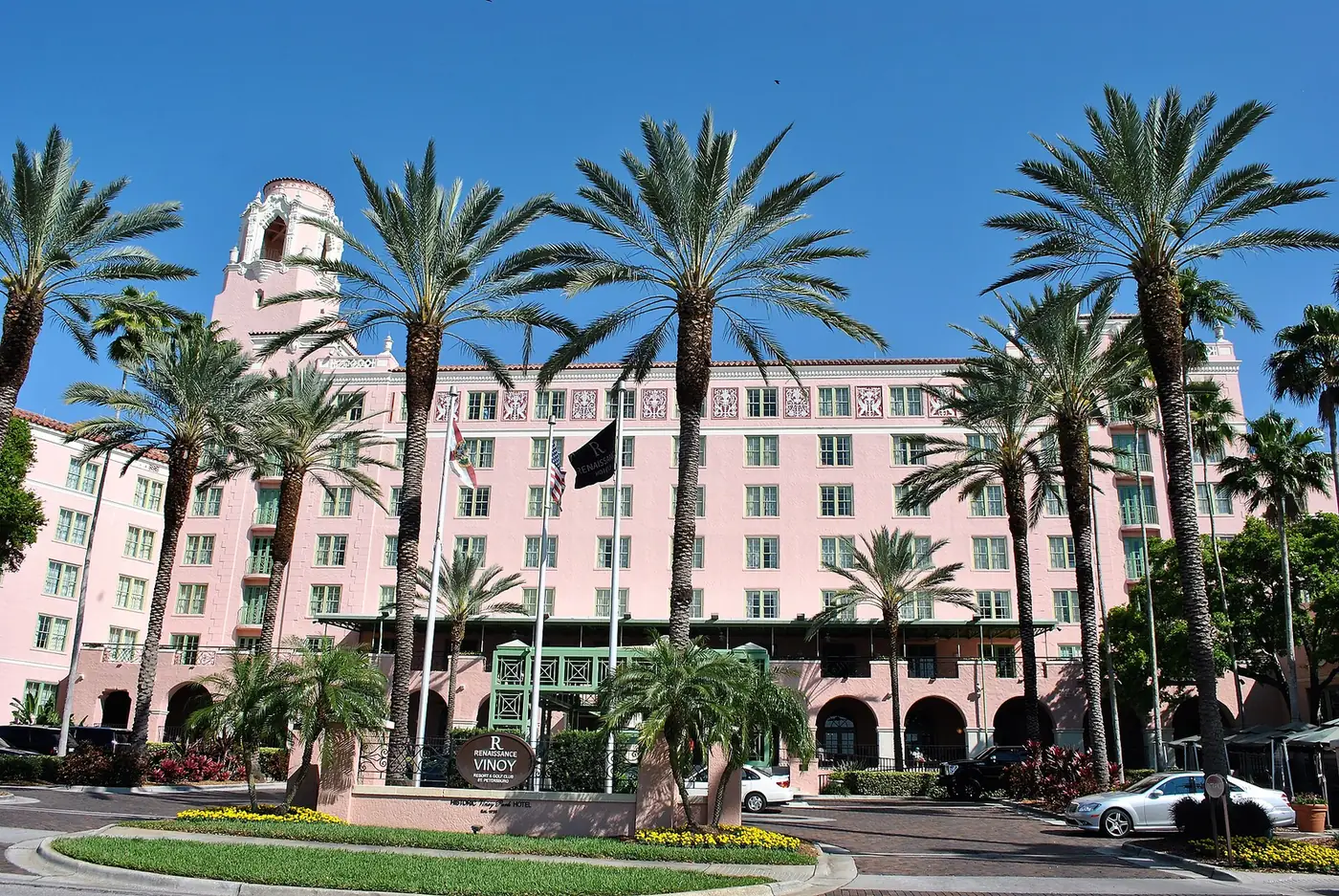
| Vinoy Park Hotel | 501 5th Ave. NE | 1978 |
| Casa Coe da Sol | 510 Park St. | 1980 |
| Veillard House | 262 4th Ave. N | 1982 |
| Snell Arcade | 405 Central Ave. | 1982 |
| Central High School (St. Petersburg High) | 2501 5th Ave. N | 1984 |
| Alexander Hotel | 535 Central Ave. | 1984 |
| Casa de Muchas Flores | 1446 Park St. N | 1985 |
| Studebaker Building | 600 4th St. S | 1985 |
| Dennis Hotel | 326 1st Ave. N | 1986 |
| Potter House | 577 2nd St. S | 1986 |
| St. Petersburg Public Library | 280 5th St. N | 1986 |
| Boone House | 601 5th Ave. N | 1986 |
| First Methodist Church | 212 3rd St. N | 1990 |
| St. Petersburg Woman’s Club | 40 Snell Isle Blvd. | 1994 |
| Green-Richman Arcade | 689 Central Ave. | 1998 |
| Domestic Science and Manual Training School | 440-442 2nd Ave. N | 1999 |
| S.H. Kress and Company Building | 475 Central Ave. | 2001 |
| Sanitary Public Market | 1825 4th St. N | 2002 |
| Maurice and Thelma Rothman House | 1018 Park St. N | 2013 |
| John and Florence McKeage House | 209 Park St. S | 2013 |
| James Henry House | 950 12th St. N | 2013 |
| Sunset Hotel | 7401 Central Ave. | 2014 |
| Huggins-Stengel Field | 1320 5th St. N | 2019 |
| Peninsular Fruit Company Building | 10000 Gandy Blvd. N | 2023 |
The city also designates its own local landmarks and districts; see the historic preservation page.
Museums and self-guided tours
- The Dalí Museum, One Dali Blvd.: daily 10 a.m. to 6 p.m., Thursdays to 8 p.m. (thedali.org).
- Pinellas Pioneer Settlement at Boyd Hill Nature Preserve, 3010 31st St. S.
- African American Heritage Trail: two self-guided walks with 19 markers, both starting at the Woodson museum (trail guide).
- Historic Outdoor Museum of Roser Park: 28 markers on a neighborhood walking tour (historicroserpark.org).
- Downtown and Waterfront Walking Tours: three routes, self-guided or with a docent from St. Petersburg Preservation (walkingtourstpete.com).
What this means for you
- Start at the Museum of History on the waterfront, then walk the downtown district.
- Thinking of changing a historic home? Check the preservation rules first; see permits and zoning.
More: population and growth and parks and trails.
Frequently asked questions
When was St. Petersburg, Florida, founded?
The town of St. Petersburg was incorporated on Feb. 29, 1892, and reincorporated as a city in 1903. The first train on the Orange Belt Railroad arrived in 1888.
Why is St. Petersburg named after the Russian city?
According to the city, legend says John C. Williams and Peter Demens flipped a coin to name the town. Demens won and named it after St. Petersburg, Russia; Williams named the first hotel the Detroit, after his birthplace.
What are the historic districts in St. Petersburg?
National Register districts include Downtown St. Petersburg (2004), Roser Park (1998), North Shore, Kenwood and Round Lake (all 2003), plus the St. Petersburg Lawn Bowling Club (1980).
Who were the first Black settlers in St. Petersburg?
John Donaldson and Anna Germain, who arrived in 1868 and homesteaded near what is now 18th Avenue S and 31st Street S, according to the city.
Have your say