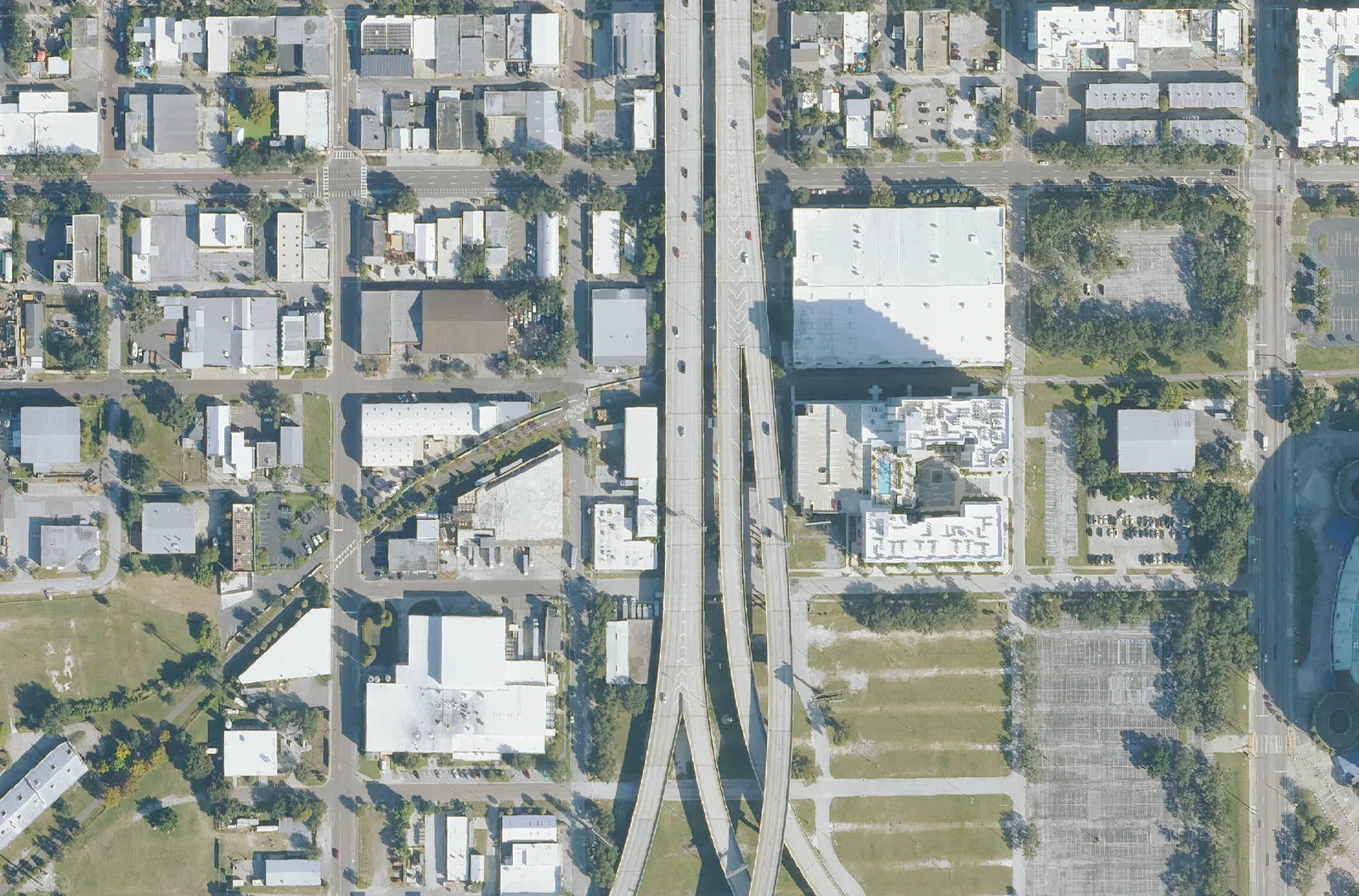
City Council voted 8-0 to accept the Trails Crossing plan for a linear park under I-275. A nonprofit is to lead fundraising, and no city money is committed yet.
St. Petersburg City Council has accepted a master plan to turn the land under Interstate 275 west of downtown into a linear park built around the Pinellas Trail. The plan puts the full cost at about $54.5 million, spread over three phases.
The council voted 8-0 on Nov. 5 for the resolution, which also backs city staff moving ahead with the plan’s recommendations. The vote is recorded in the council’s action-taken agenda for Nov. 5. The staff report and the full plan are in the Nov. 5 agenda packet, a very large PDF.
Where it is
The plan covers the land beneath I-275 between 18th and 19th streets. Its study area runs from Burlington Avenue North down to 5th Avenue South. The detailed design focuses on the stretch from 3rd Avenue South to 1st Avenue North.
That is where several districts meet: the Grand Central District, the EDGE District, the Warehouse Arts District, the Kenwood Historic District and the Historic Gas Plant District around Tropicana Field. Campbell Park and the Melrose-Mercy neighborhood lie just to the south.
The plan says building the interstate displaced residents, divided historic districts and left few crossings. The city calls the space under it “underutilized” in the staff report.
What would be built, and when
The plan sets out the work in stages. Only the first ones have target years:
- Phase 0, 2026 to 2029: landscaping, temporary art, pop-up events and regular programming. It starts with “Trails Oasis,” a resting stop for trail users on the Pinellas Trail directly under I-275.
- Phase 1A, target 2029 to 2031: a permanent Trails Oasis, an outdoor market plaza, a planted stormwater swale and public art. 18th Street would become a pedestrian- and bicycle-priority street from the Pinellas Trail north through Central Avenue to 1st Avenue North, with raised crosswalks and other crossing improvements.
- Phase 1B, target 2029 to 2031: the stretch from about 3rd Avenue South to 5th Avenue South, with a terraced lawn amphitheater, a sculpture garden and parking.
- Phases 2 and 3: the central and northern sections, with more east-west connections, landscaping and nature-based programming. The plan gives no target years for these.
What it would cost
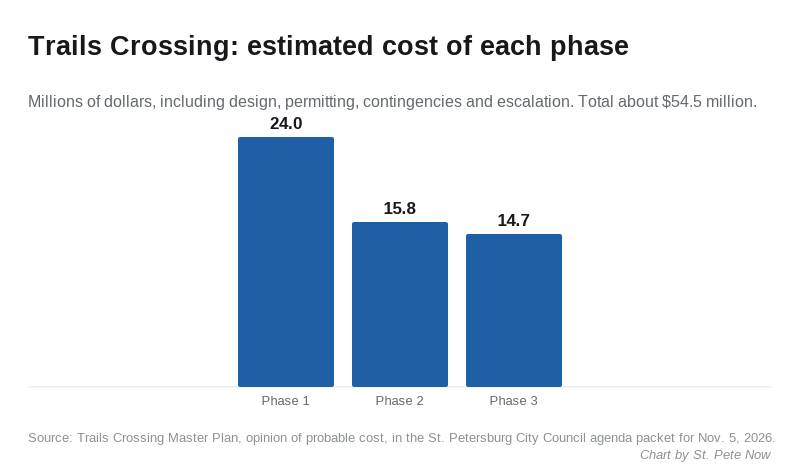
The plan’s cost estimate is based on 2026 prices, with inflation added for each phase. It calls the figures “order-of-magnitude” and says they will change as design moves forward.
| Phase | Estimated cost |
|---|---|
| Phase 1 (1A and 1B) | about $24 million |
| Phase 2 | about $15.8 million |
| Phase 3 | about $14.7 million |
| Total | about $54.5 million |
Who pays
The vote does not spend city money. The staff report says the park is expected to be a public-private partnership with Friends of Trails Crossing, a Florida nonprofit. The nonprofit “is expected to lead fundraising and grant pursuits,” the report says.
The city may help case by case. That could mean sponsoring grants, matching funds or staff time. The report says any of it would depend on the budget and on further council votes. It adds that the city’s level of support “has not been established.”
The plan also looked at running the park as a self-funding business and advised against it. It points to the St. Pete Pier, which earns about $1.5 million a year from leases and events but still needs city support.
How it got here
The council approved a funding agreement with Friends of Trails Crossing and a design contract with LandDesign Inc. in March 2025. The plan drew on:
- 389 responses to an online survey that ran for 49 days
- 75 people at open houses on Aug. 20, 2025, at the St. Petersburg Shuffleboard Club, and Jan. 29, 2026, at the President Barack Obama Main Library
- 36 stakeholder and focus group members
The top concerns were safer crossings, better walking and cycling links, more shade and space rooted in local culture, the plan says. The council’s Public Services and Infrastructure Committee reviewed it on Sept. 10 and sent it to the full council without major changes.
What happens next
The plan lists the next steps:
- keep the interim events and activities going on the site
- update the city’s agreement with the Florida Department of Transportation
- sign a memorandum of understanding with Friends of Trails Crossing
- write a business plan and fundraising materials
- sign a governance, operations and maintenance agreement
What it means for you
- Nothing closes now. The Pinellas Trail under I-275 stays open. The first changes would be landscaping, art and events.
- 18th Street could change. If Phase 1A goes ahead, it would carry a wide walking and cycling promenade from the trail to 1st Avenue North, with traffic calming and new crosswalks.
- No city money is committed yet. Any city spending on construction would need its own council vote, the staff report says.
Have your say