The city puts the $600 million water bond at about 0.96 mills, or $96 a year per $100,000 of taxable value. Bonds would be sold from 2027 to 2030 at an estimated 4.5%.
The $600 million water bond St. Petersburg voters approved Tuesday will cost property owners about $96 a year for every $100,000 of taxable value, the city estimates. That is a levy of about 0.96 mills.
The city published the figure on its 2026 General Obligation Bond page. It said Thursday that it will now “move into planning and delivering the funded projects,” in a release on the result.
The vote
The bond passed with 74% of the vote, 74,234 to 26,162, in the Pinellas County Supervisor of Elections’ unofficial results. The city’s release gives the no vote as 26,126; the county’s results file shows 26,162. The results stay unofficial until the county canvassing board certifies them. Our full election results cover the mayor’s race and the other four city questions.
“These are the systems residents depend on every day, and they often go unseen until something changes,” Mayor Kenneth T. Welch said in the release. Welch lost his re-election bid Tuesday to Charlie Crist.
What it will cost
The bond will be repaid through a dedicated property tax over time, the city said. It gives these estimates on its bond page:
- Tax: about 0.96 mills, or about $96 a year per $100,000 of taxable value
- Interest: an estimated rate of 4.5% over 30 years
- Timing: bonds sold in several series from 2027 to 2030
- Term: each series matures within 30 years of issue, under the ballot question
Your taxable value is the figure on your county tax notice after exemptions, not the market value of your home. The city has not said which year’s tax bill will first carry the levy.
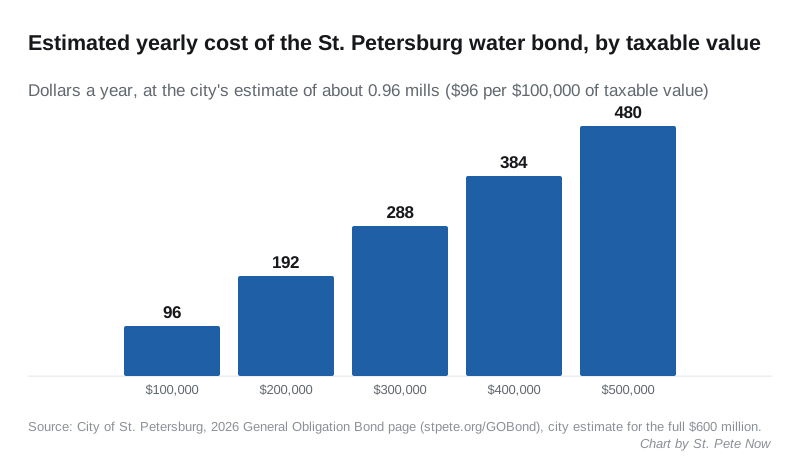
At the city’s rate, that works out to $192 a year on a taxable value of $200,000, $288 on $300,000 and $480 on $500,000.
Renters do not pay the tax directly, the city said, “although property owners may pass the costs along to renters.” Until now, these projects have been paid for through utility rates, the city’s release said.
The city also said the bond may not be the cheaper route for everyone. Over 30 years, lower-value properties typically pay less through the bond than through the utility rate increases it replaces. “For higher-value properties, the reverse may be true,” the bond page says.
What it pays for
The money can be spent only on stormwater, wastewater and drinking water work, the city said. Its bond page lists:
- Stormwater: drainage improvements, pump station upgrades and floodwater protection
- Wastewater: collection system improvements, treatment plant upgrades and system rehabilitation
- Drinking water: distribution, supply and reliability upgrades
More than half of the $600 million is planned for protecting the city’s water and wastewater utilities from storm surge, the city said. The aim is fewer outages and sewer spills in future storms.
The city has an interactive map of eligible projects. It says the materials are illustrative and may change as projects are prioritized. The work sits under the St. Pete Agile Resilience framework, or SPAR.
Who keeps watch
The projects are part of the city’s Capital Improvement Program, so City Council reviews them in the annual budget, the city said. It also plans:
- public dashboards and guides to each project
- yearly public meetings on progress and spending
- a citizen advisory group, to be set up with City Council, to check progress and report on how the money is spent
What it means for you
- If you own property in the city, expect a new bond line on a future tax bill. See property taxes in St. Petersburg for how your bill is set and how to appeal your value.
- If you rent, you will not see the levy directly, but your landlord pays it.
- To see what is planned near you, open the city’s project map and search your address.
- To follow the spending, watch for the citizen advisory group and the first yearly meeting. We will report both when the city announces them.
Have your say